Building a pole barn is one of the most cost-effective ways to create lasting storage, agricultural, or workshop space. But the savings shouldn’t end when construction does. Today’s landowners and business operators are learning that smart construction practices—from site planning to insulation—can significantly reduce long-term operating costs. Whether you use your pole barn for livestock, vehicles, or as a hobby shop, energy efficiency and sustainability are the key to preserving your investment.
Plan the Site for Long-Term Efficiency
Before construction begins, the site itself plays a major role in determining how much you’ll spend on utilities over time. Many builders overlook the simple but powerful principle of strategic placement.
Choose a location with the right solar orientation. Placing your barn so it faces the sun in winter and minimizes exposure in summer can help naturally regulate internal temperatures. South-facing windows bring in warmth and light, while overhangs or shade trees can reduce summer heat gain.
Good site drainage is another money-saving move. Keeping water away from the structure protects the foundation, reduces frost heaving, and minimizes future repairs. Proper grading around the perimeter, along with a gravel base, can improve moisture control and structural stability.
Invest in a Strong, Efficient Building Envelope
A “building envelope” refers to all the parts that separate the interior from the exterior—walls, roof, doors, and windows. In pole barn construction, the right materials make a measurable difference in energy efficiency and durability.
Start with high-quality framing lumber and a properly designed truss system to distribute loads efficiently. Adding secondary framing (known as “girts” and “purlins”) improves wall and roof performance. When installed correctly, these systems reduce air leaks and help insulation work at full potential.
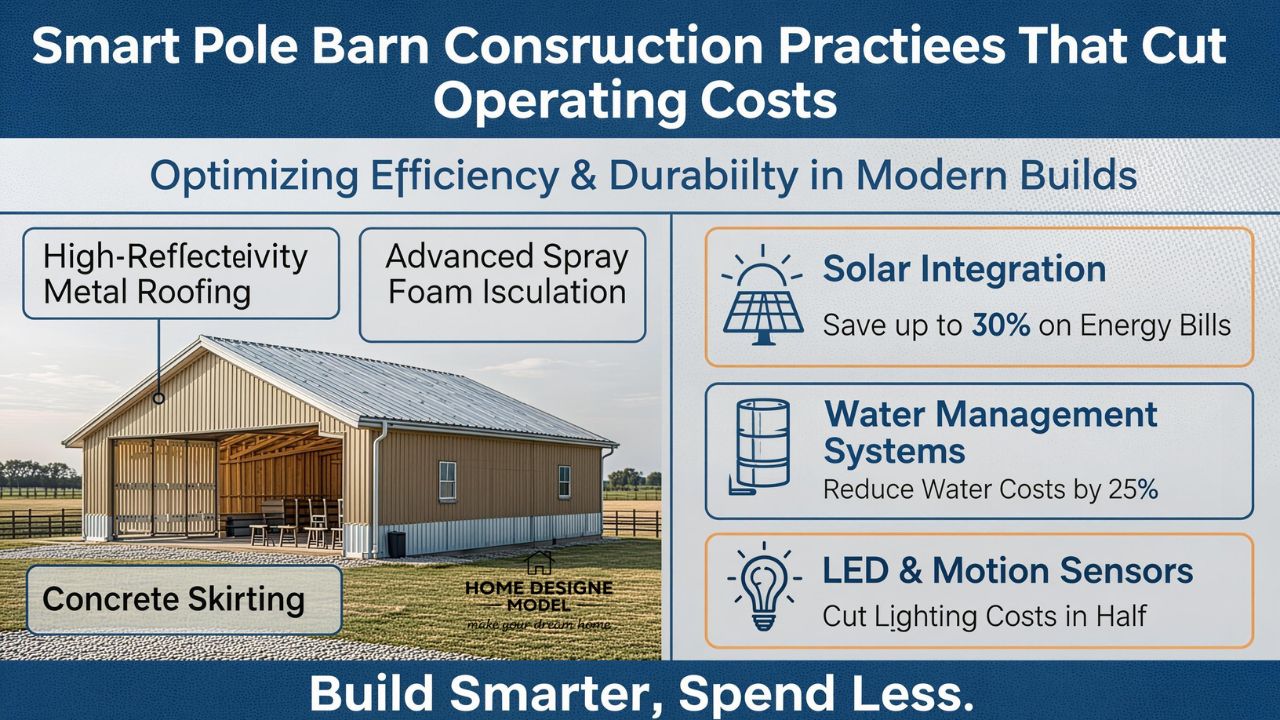
For roofing and siding, consider metal panels with reflective coatings that deflect sunlight. Light-colored finishes can dramatically reduce heat absorption, keeping the building cooler in summer and lowering energy consumption if your barn has ventilation fans or HVAC units.
Optimize Insulation and Air Sealing
Insulation is one of the biggest factors influencing annual energy costs. A well-insulated pole barn maintains consistent temperature and humidity, protecting both equipment and livestock. Spray-foam insulation has become popular for its ability to seal tight spaces and prevent moisture infiltration.
Equally important is air sealing. Gaps around windows, doors, and joints allow conditioned air to escape, forcing your heating or cooling system to work overtime. Caulking and weatherstripping during construction prevent this loss before it starts.
If you’re unsure where to begin, consulting a professional installer or the best insulation company for pole barns can ensure you choose the right products for your climate and barn design. While insulation may look like a big upfront expense, it quickly pays for itself by slashing heating and cooling costs for years to come.
Leverage Ventilation for Passive Savings
Ventilation isn’t just about air quality—it’s about maintaining comfortable, stable conditions without mechanical input whenever possible. A balanced ventilation system includes both intake and exhaust.
Ridge vents and eave vents are standard features that allow warm air to escape naturally. In colder months, controlled ventilation prevents moisture buildup, reducing the risk of mold and structural rot. Adding solar-powered fans is another cost-conscious step; these run without drawing electricity from the grid, providing an eco-friendly boost to airflow.
Use Smart Lighting Solutions
Lighting is another overlooked opportunity for savings. Natural daylighting strategies—such as skylights or translucent wall panels—dramatically reduce the need for electric lighting during daylight hours. Position these panels to capture southern sunlight while minimizing summer glare.
For artificial lighting, switch to LED fixtures. LEDs use up to 80 percent less electricity than traditional bulbs and last far longer, cutting both energy and maintenance costs. Motion sensors or smart timers can further reduce unnecessary use, ensuring that lights run only when needed.
Prioritize Material Lifespan and Maintenance Access
Cutting operating costs isn’t only about energy—it’s also about reducing maintenance. Opt for corrosion-resistant fasteners, galvanized steel panels, and treated lumber for posts that contact the ground. These materials may cost slightly more initially but save significantly on replacement and labor costs over time.
Design your barn with accessibility in mind. Leave room to easily inspect plumbing, wiring, and insulation. Install gutters and downspouts that are simple to clean. Integrated design foresight ensures regular upkeep stays quick and affordable.
Incorporate Renewable Technology
Once the basic structure is efficient, adding renewable energy amplifies your savings. Solar panels are the most common option for pole barns, providing electricity for lighting, tools, and small equipment.
For larger operations, geothermal systems or biomass boilers can efficiently provide heating. Even modest renewable additions—such as small wind turbines or solar-powered fans—can generate cumulative savings that accumulate each year.
Think Holistically: Construction and Operation as One System
The smartest approach to pole barn construction looks beyond the initial cost. Instead, it integrates the entire building lifecycle—from materials and orientation to energy use and long-term maintenance. Builders and owners who invest strategically in efficiency find their barns are not just cheaper to run but also more comfortable, more durable, and environmentally responsible.
Every choice in the design and construction process either adds to or subtracts from future expenses. By making efficiency a core value from the start, you pave the way for lower operating costs, longer building life, and a more sustainable property—values that stand the test of time season after season.